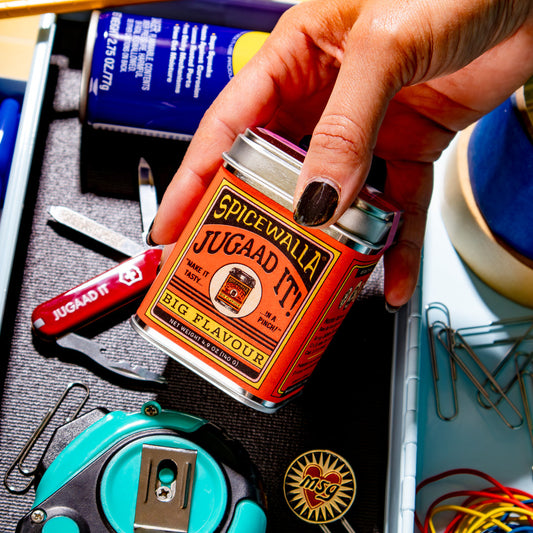


Most spice blends are about addition. More flavour, more complexity, more ingredients working together to create something specific.
Jugaad It is about foundation. It's the three things that, in the right balance, make almost any food taste more like itself. "The goal of every blend is optimum flavour and balance. Jugaad It is special because only three ingredients were needed to achieve that goal." - Alyse Baca, Spicewalla's Culinary Director
Salt. Sugar. MSG. That's it.
We know that's a provocative ingredient list. So, let's talk about why these three things, and why this combination works!
Salt: The Reason Anything Tastes Like Anything
Salt is the most fundamental seasoning in cooking, and it's worth understanding why.
Salt doesn't just add saltiness. It suppresses bitterness, which means bitter notes in food become background texture instead of foreground flavour. It amplifies sweetness. And it draws water out of ingredients, concentrating their natural flavours. A pinch of salt in chocolate chip cookie dough doesn't make the cookies salty. It makes them taste more like chocolate!
In Jugaad It, salt is the base layer. It's what opens everything up. Without it, the other two ingredients have less to work with.
Sugar: The Balancer
In a savory blend, sugar's job isn't to make food sweet. It's to make food balanced.
Sharp acidity, hard bitterness, and harsh salinity all respond to a small amount of sugar in the same way. They soften. They round out. The dish stops fighting itself and starts tasting like a cohesive thing!
This is why almost every well-developed sauce has a touch of sweetness. Why a great vinaigrette balances acid with something sweet. Why caramelized onions, which develop natural sugars as they cook, make everything they touch taste more complete. Sugar is the ingredient that makes a dish feel finished!
In Jugaad It, it's the bridge between salt and MSG. Without it, the blend would be functional but uneven. With it, the three ingredients work together.
MSG: The Fifth Taste
MSG stands for monosodium glutamate. It's the sodium salt of glutamic acid, one of the most abundant amino acids on earth, and one your body already produces.
Glutamate is naturally present in tomatoes, Parmesan cheese, mushrooms, soy sauce, and miso. It's the reason a slow-cooked bolognese tastes so different from a quick pasta sauce. The reason aged cheese has that complexity that fresh cheese doesn't. The reason a ripe summer tomato, eaten plain, can taste like an entire meal.
That quality has a name: umami.
The fifth basic taste, alongside sweet, sour, salty, and bitter. Umami is the deep, savory, mouth-coating sensation that makes food feel satisfying and makes you lean in for another bite. MSG is its concentrated, isolated form, chemically identical to the glutamate that occurs naturally in food.
Top Chef 2024 Finalist Shuai Wang says it best! "Used appropriately, MSG is absolutely delicious. It's like the thing you love about eating cheese — everyone loves a good parmesan with those little crystal bites of salt, and that little tartness you can't quite put your hand on. That's naturally occurring MSG. Between that and mushrooms and tomatoes, all these things give you a little jolt of flavour — and that's what MSG does."
In Jugaad It, MSG does two things: it adds depth that salt and sugar alone can't provide, and it makes the other flavours in whatever you're cooking more pronounced. It amplifies what's already there.
Alyse Baca, Spicewalla’s Culinary Director and educator explains, "understanding seasoning is the first thing I teach anyone who wants to cook better. MSG is not a flavour, it's a volume dial for every other flavour in the dish."
What MSG Is
MSG stands for monosodium glutamate.
It's the sodium salt of glutamic acid, one of the most abundant amino acids on earth and one your body produces naturally every day. It's present in tomatoes, Parmesan cheese, mushrooms, soy sauce, miso, anchovies, and hundreds of other foods people have eaten throughout history without a second thought.
MSG was first identified in 1908 by Japanese professor Kikunae Ikeda, who isolated it from kombu seaweed while studying the compound responsible for a distinct savory taste he couldn't categorize as sweet, sour, salty, or bitter.
He called that taste umami. Within a year, commercial production began. For the next several decades, MSG was widely used in American and international cooking!
How MSG Is Made
Today, MSG is produced through fermentation, the same process used to make yogurt, vinegar, and wine.
Manufacturers ferment natural carbohydrates from sugar cane, sugar beets, corn, or cassava using specific bacteria. The fermentation produces glutamic acid, which is then isolated, combined with sodium to make it stable, and dried into crystals. The end result is chemically identical to the glutamate found naturally in food.
The Three Together
The reason these three ingredients work so well as a blend is that they each operate differently in the mouth.
Salt works immediately and broadly, opening everything up.
Sugar works on the mid-palate, smoothing out edges.
MSG extends the duration of flavour.
Together, they cover the full arc of how flavour is experienced. That's the holy trinity Meherwan talks about when he describes Jugaad It: not just three individual ingredients, but three complementary mechanisms.
How to Use It
The answer is: on almost anything. But here's where we've been testing it, if you want a starting point.
Fresh sliced tomatoes or cucumbers, before you make your tomato sandwich. This one is worth doing first. It shows you immediately what MSG does to something you already think you know.
On popcorn straight from the microwave. In the bowl, before you pour the noodles on top. The question to ask isn't 'what can I put this on?' It's 'what am I cooking that's almost there but missing something.' That's where Jugaad It goes.
For a complete list of the ways the Spicewalla team has been using Jugaad It, check out this blog post: Everything You Can Do With Jugaad It (We've Been Testing This for Weeks)