


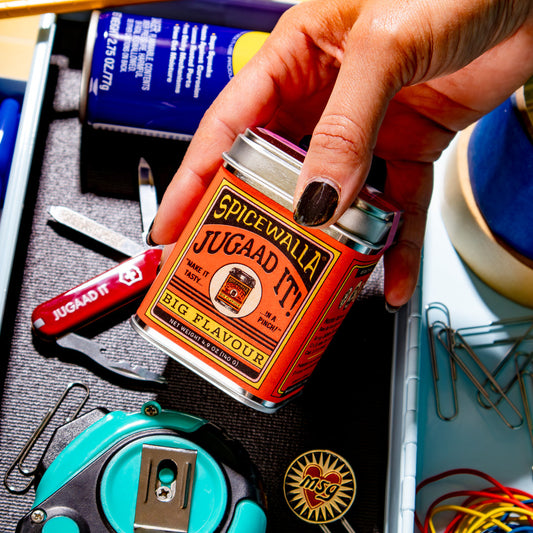
Somewhere in your kitchen right now, you probably have an ingredient with more natural glutamate in a single serving than MSG you'd shake from your Jugaad It tin.
If you have soy sauce, Parmesan cheese, miso, tomatoes, mushrooms, broccoli, green peas, anchovies, chicken breast…you’ve got naturally occurring glutamate in your kitchen.
And yet MSG, the isolated form, has spent more than fifty years as the most unfairly maligned ingredient in American cooking.
Here's how that happened.
Before 1968: MSG Was Celebrated
MSG was discovered in 1908 by Professor Kikunae Ikeda at the University of Tokyo. Working with dried kombu seaweed, the base of Japanese dashi, he isolated the compound responsible for its deep, savory taste, identified it as glutamic acid, and coined the term umami to describe it.
Within a year, commercial production began under the brand Ajinomoto.
By the mid-twentieth century, MSG was widely used in American cooking. It appeared in canned soups, seasoning blends, restaurant kitchens, and military rations. Food companies marketed it as a flavor enhancer. Home cooks used it; nobody was alarmed.
April 4, 1968: The Letter That Changed Everything
On April 4, 1968, the New England Journal of Medicine published a letter from a physician named Dr Robert Ho Man Kwok.
Kwok described a pattern of symptoms he experienced after eating at Chinese restaurants serving Northern Chinese food: numbness at the back of his neck radiating to his arms, general weakness, and heart palpitations. He offered three possible causes: cooking wine, high sodium content, or perhaps MSG, and asked if any of his medical colleagues had thoughts on the matter.
The editors gave his letter a name: Chinese Restaurant Syndrome.
Kwok himself was not claiming MSG was the cause. He was speculating about three possibilities and asking for research. But the name stuck, the media ran with it, and over the following months, the New England Journal published ten responses from other physicians who also reported discomfort after eating Chinese food.
Notably, none of the respondents reported the same symptoms!
Some had numbness, some had flushing, some had back spasms, and some had dizziness. The symptoms were so different from person to person that they had little in common.
The Studies That Followed Were Flawed
The studies conducted throughout the 1970s and early 1980s that purported to link MSG to symptoms were, almost uniformly, deeply problematic.
Small sample sizes. No blinding. Rats given doses wildly disproportionate to any human eating pattern. No placebo controls. When properly designed, double-blind studies were conducted where neither the participant nor the researcher knew who received MSG and who received a placebo. People who identified as MSG-sensitive consistently could not distinguish between the two.
The science never confirmed Chinese Restaurant Syndrome. The fear ran ahead of the evidence, and the evidence never caught up.
"There is not one scientific paper to prove that it's bad for you. The MSG scare is complete and utter nonsense." - Heston Blumenthal, Chef
What the Regulatory Record Actually Shows
MSG has held GRAS status (Generally Recognized As Safe) with the FDA for decades.
In the 1990s, due to public concern generated by the Kwok letter and subsequent media coverage, the FDA commissioned an independent scientific review of all MSG research. They affirmed GRAS status and have maintained that position for over three decades.
The World Health Organization, the Joint FAO/WHO Expert Committee on Food Additives, and the European Food Safety Authority all classify MSG as safe. The EFSA set a conservative precautionary Acceptable Daily Intake of 30mg per kilogram of bodyweight per day, a figure built on a 100-fold safety margin from no-adverse-effect levels observed in animal studies.
For context, according to WebMD:
- Fresh tomatoes have up to 250 milligrams of glutamate per 100 grams.
- A 100-gram serving of grape juice has 250 milligrams of glutamate, which is about ⅔ of a cup.
- And you'll find the highest levels of glutamate in Parmesan and Roquefort cheeses! Parmesan contains 1,680 milligrams of glutamate per 100 grams, and Roquefort contains 1,280 milligrams per 100 grams.
All foods people consume without a second thought!
The Cultural Dimension
It's impossible to tell this story honestly without noting what it took for the story to spread the way it did.
Italian and French cuisines, both of which are extremely high in natural glutamates, were never subjected to this kind of scrutiny. Parmesan, one of the highest natural sources of glutamate in any pantry, has never had a 'No Parmesan' sign on a restaurant window.
The suspicion landed specifically on Chinese food, and the name Chinese Restaurant Syndrome encoded that suspicion directly into the medical and public vocabulary.
Kim Pham, co-founder of Omsom, the Asian food brand that was among the first to proudly list MSG as an ingredient, put it plainly: 'It's really hard to talk about the Asian-American experience without talking about MSG.'
In 2019, Ajinomoto, the company that commercialized MSG in 1909 and has led the science-based effort to rehabilitate it, successfully lobbied Merriam-Webster to revise the definition of ‘Chinese Restaurant Syndrome’, which the dictionary ultimately updated to reflect that the term is considered dated and offensive. In 2020, Ajinomoto launched its 'Know MSG' campaign to address the misinformation on MSG>
Chef Calvin Eng, owner of Cantonese-American restaurant Bonnie's in Brooklyn and a member of Ajinomoto's Umami Collective, has become one of the most vocal advocates for MSG in the country. He has MSG tattooed on his arm. Almost everything on his menu contains it. And he’s openly shared, "the stigma really has pushed people away from our food."
In his cookbook Salt Sugar MSG, Eng writes: 'I don't add MSG to recipes for the controversial shock factor. I truly believe the seasoning adds something you can't achieve with just salt and sugar alone.'
And we can’t agree more! It’s why we created Jugaad It.
How MSG Is Made
Today, MSG is produced through fermentation, the same process used to make yogurt, vinegar, and wine.
Manufacturers ferment natural carbohydrates from sugar cane, sugar beets, corn, or cassava using specific bacteria. The fermentation produces glutamic acid, which is then isolated, combined with sodium to make it stable, and dried into crystals. The end result is chemically identical to the glutamate found naturally in food.
Where Things Stand Now
The rehabilitation of MSG is well underway.
Due to Ajinomoto's sustained awareness campaign, Know MSG, more than 34 million US consumers have changed their opinions to state they believe MSG is safe to eat.
In 2021, Whole30, one of the most influential elimination diet programs in the US, announced it would no longer classify MSG as off-limits, citing a reevaluation of current science and its diversity and inclusion values.
Restaurants now openly celebrate MSG on their menus. The conversation around MSG is shifting, and we think that's a good thing!
We put MSG front and center because we think it belongs there.
"People already are talking about MSG, and it's about damn time. It's gotten a bad rap. It's the bad guy in every movie. Why? For so many years, we've deprived ourselves of the wonder and glory of MSG. But a lot of its myths have been debunked. You'll find glutamate naturally occurring in things like parmesan cheese, miso, and tomatoes. So go ahead and jugaad it, baby." - Meherwan Irani, Founder, Spicewalla
Your Truth About MSG
Food is personal. And the truth is, plenty of ingredients that are safe for most people simply don't work for everyone. Garlic. Mustard. Sesame. Onion. These are whole, natural foods with no PR problem whatsoever! And yet for some people, they cause real reactions. That's not a scandal. That's just how bodies work.
MSG is no different in that respect. It comes from a naturally occurring compound, present in foods you've probably eaten your whole life without a second thought. The science is clear on its safety, and decades of regulatory review across multiple continents back that up.
But science describes populations, not individuals.
If MSG doesn't work for you, that's real, and it's worth paying attention to.
We made Jugaad It because we believe in this ingredient and what it does for flavour. We put it on the front of the label because we think you deserve to know exactly what's in your tin. And if it's not for you, we have more than 200 other spices and blends that are! No hard feelings, and no fine print.
We trust your experience and your body. Thank you for giving us this opportunity to share.

1 comment
Thank you for this! I’ve been singing its praises for years, so I’m always glad when I see it!