

There is a word in India that has no clean English translation. Jugaad. Pronounced joo-GAAD. It shows up in conversations across India the way Americans might say resourceful, or scrappy, or making it work, except it carries more weight than any of those. Jugaad is a philosophy. A survival skill. An art form that billions of people practice without ever calling it by name.
Meherwan Irani grew up with it. And naturally, it found its way into all of the businesses he’s built.
Growing Up in Ahmednagar
Meherwan was born in London, but his earliest food memories belong to India.
His family moved back when he was young, settling in Ahmednagar, a small city in Maharashtra in the midwestern part of the country. His mother's kitchen was where his education began, and it was an education that defied category.
His mother had spent time in England and Italy before returning to India. She had absorbed North Indian family recipes, Parsi dishes from his father's side, Italian pasta techniques, and whatever she picked up from Western travellers passing through the family's guesthouse.
She moved between all of it freely. Not because she was trying to be creative, but because she was trying to make things taste good with what she had. If a dish needed something and she didn't have it, she found the closest thing that worked and made it better. Her meatballs were spiced like kebabs. Her tomato sauce carried turmeric. Her guests would say it was the best version of the dish they'd ever had.
"She didn't go to culinary school. She didn't go to college. But she mastered so many things. I didn't realise until I was a little older that something remarkable was happening in my mom's kitchen." - Meherwan Irani, Spicewalla founder, co-owner of Chai Pani Restaurant Group
That was jugaad. She wasn't cutting corners. She was finding the most creative, resourceful path through every constraint. And her food was better for it.
What Jugaad Actually Is
The word jugaad is used across India to describe a clever, improvised fix. Not a workaround in the resigned sense. Not settling for less.
It's closer to the recognition that limitations spark creativity. That the best solution is often the simplest one. That you don't need everything. You need to understand what you have.
"'Jugaad' is a term used throughout India to describe the reliance on ingenuity to make something happen with what you have, instead of waiting to have all the right parts or pieces. Sometimes it means bending the rules, or getting inventive with your resources." - Molly Irani, co-founder of Chai Pani Restaurant Group, from her book Service Ready
It shows up everywhere in Indian life. A farmer builds a makeshift vehicle from a water pump engine and gets his harvest to market. A street vendor in Mumbai sets up a single gas burner on a corner and feeds hundreds of people before noon, developing a menu over years of working within the same narrow constraints until those constraints have produced something extraordinary. In a country of more than a billion people, jugaad isn't a concept you study. It's a reflex you develop.
Molly said it best in Service Ready, “"Jugaad is about more than making do with less. It has to do with ingenuity and thinking outside the box."
Meherwan has clearly described this side of Indian street food in interviews - it is prepared by migrants from the countryside who must transcend every boundary, preference, and restriction. That produces the most creative, inventive food in the world. And, it's why he chose to bring this food to the US.
"Street food is the most Pan-Indian food that you can put on the plate. It must transcend all sort of religious boundaries, ethnic boundaries, and be approachable. I knew it would be a perfect vehicle to show India off to everybody.” - Meherwan Irani
From Ahmednagar to Asheville
Meherwan came to the United States at 20 to get his MBA. He spent a decade in luxury marketing and sales, Lexus and Mercedes-Benz, before the recession took that career away. But he didn’t see it as a setback; he just leaned into jugaad.
In 2009, at the bottom of the recession, he and Molly quit their jobs and opened Chai Pani, a small Indian street food restaurant in downtown Asheville, North Carolina.
No culinary school. Funded by themselves, family, and friends.
On opening day, they ran out of food.
By 2022, Chai Pani was named the most Outstanding Restaurant in America by the James Beard Foundation.
The philosophy behind Chai Pani was the same one his mother had practiced in her kitchen in Ahmednagar: make it approachable, make it honest, and make it taste good using exactly what you have. Meherwan has described the restaurant's guiding principle as 'authentic but not traditional', which is jugaad applied to a dining room.
Then came Botiwalla, the fast-casual Indian street food restaurant beloved by anyone who has a chance to taste it!
Molly writes in Service Ready, “It became second nature for us to use the term 'jugaad' when directing our team. When someone would say, 'But we don't have x, y, z,' our answer was, 'Jugaad it.' This was our code for 'get creative, figure it out, work with what we have.' It became part of the DNA of Chai Pani and informed how we did just about everything in those early years...Now, the art of jugaad is woven into everything we do. It helped us start the business, and it ensured we survived the Covid pandemic. It's one of the essential bricks in the foundation that our company is built upon."
Enter Spicewalla
Jugaad doesn't mean staying small. It means knowing when the constraint you're working within can become the foundation for something bigger.
Spicewalla started as an internal need. Meherwan was sourcing spices for his restaurants and realized that what he had access to, which was fresh, carefully sourced, and properly handled, was dramatically better than what home cooks could find in grocery stores. Other chefs started noticing the spices at Chai Pani and asking where they came from. The demand was already there. He just needed to meet it.
That's jugaad, y’all.
Spicewalla wasn't built from a business plan. It grew from a real problem with a real solution that turned out to be bigger than anyone expected. The company now carries hundreds of global spices and blends, is sold in over 1,300 independent retailers across the country, and helps spread love through food.
Like Meherwan said, "we launched Spicewalla to bring fresh spices to restaurant kitchens like ours. We wanted to democratize the kind of quality that professional kitchens take for granted."
The goal at Spicewalla has always been the same thing his mother practiced: strip away the gatekeeping, trust people to cook well when they have good ingredients, and make great food more accessible to everyone.
That's the philosophy across all three businesses. Chai Pani. Botiwalla. Spicewalla. It started in a kitchen in Ahmednagar with a woman who made the best version of every dish she ever touched, using exactly what she had.
Meherwan has spent his whole career doing the same thing. And so have we ❤️
And Then There Was Jugaad It
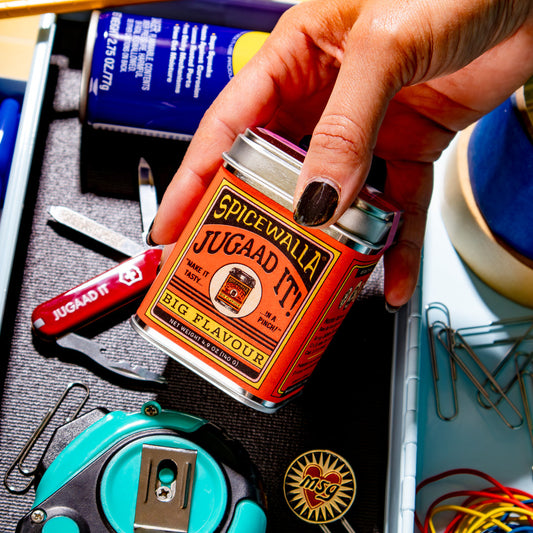
The product called Jugaad It is the most literal expression of that philosophy we've made yet. Three ingredients: salt, sugar, and MSG.
The idea is simple: these three things, in the right balance, form the foundation of flavour in almost any dish. You don't need a full pantry. You need the right three things and the instinct to use them.
It's a provocation and a proof of concept at once. The name is the whole point. When your food is almost there but missing something, you don't need more complexity. You need to jugaad it.
"Jugaad It is the most honest product we've made. Three ingredients. No more, no less. It's the philosophy in a tin." - Meherwan Irani