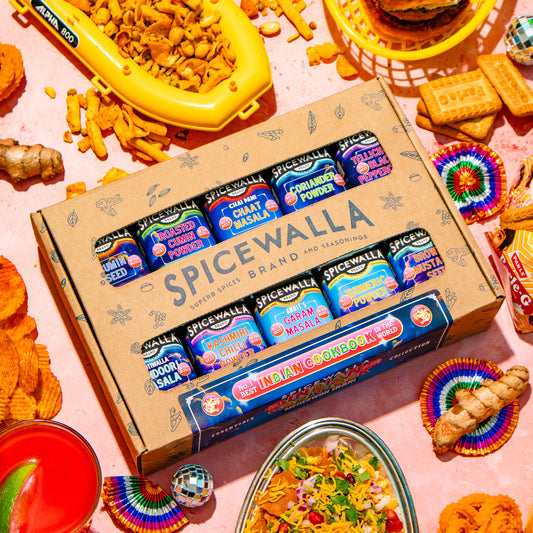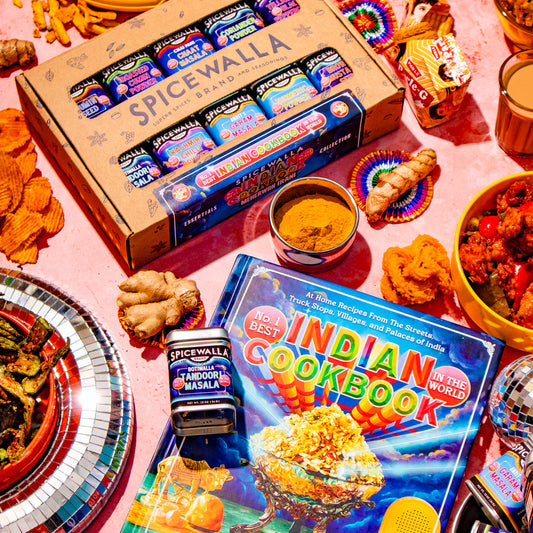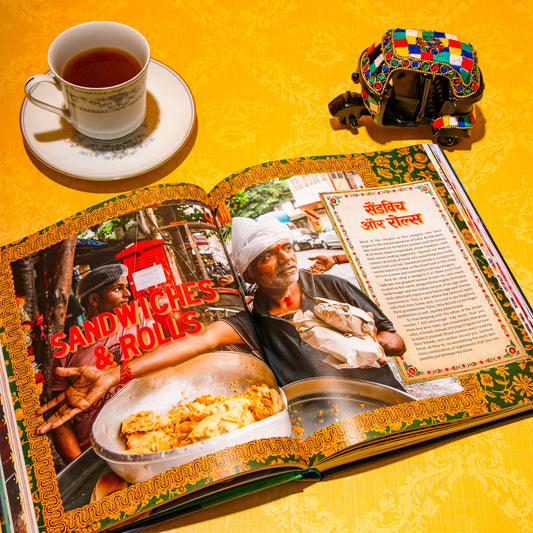


We take different approaches to curating collections of spices. Sometimes it's based on flavour profiles, sometimes on global reach. For this collection, it came down to a spreadsheet, a cookbook, and a Virgo with a mission 🤘🏼
To create this collection, I went through the whole cookbook with a spreadsheet open next to me, logging every spice, herb, and blend in every recipe. I'd like to report that this was rigorous, analytical work. It was not. I was hungry the entire time. You can't log the chaat chapter into a spreadsheet without stopping at least twice to eat some Masala Magic chips.
The Results
Some of it went how you'd expect.
Turmeric turned up constantly, which is roughly what anyone would guess. The thing at the very top of the list was Kashmiri chilli, and it edged out turmeric. The most-called-for ingredient in the whole book is the one most American cooks treat as optional.
What came out the other side is this 10-pack. Ten tins, and not one is in there for decoration. Rather than walk you through all ten in a row, which is how you forget all ten, I've sorted them the way they'd sit on a counter:
- the tadka tins
- the masala tins
- the aromatic tins
- the finishing tins
Read it once, and you'll have a working map of the book.
The tadka tins
Brown Mustard Seed and Cumin Seed are whole, and they go in first, into hot fat, before anything else exists. This is the tadka, and it’s the technique the entire book runs on.
Mustard seed needs the most time and the most heat. Drop a single seed in and wait for it to pop, which is the only oil thermometer anybody in an Indian kitchen has ever needed. Then add the rest. They'll crackle hard for about thirty seconds, loud enough that you'll want a lid.
Cumin seed goes in after, and it burns much faster, so you're looking at ten or fifteen seconds until the colour darkens a shade and the smell turns nutty.
The whole thing takes under a minute. It's also the difference between a dal that tastes like something and a dal that tastes like lentils, and it's the step most Western recipes quietly skip, usually by telling you to add ground cumin to the onions and moving on.
One warning worth putting in writing: burnt cumin cannot be saved. It goes acrid and stays acrid, and it will find its way into every bite of whatever you build on top of it. Dump the pan, wipe it out, start over. That costs you a tablespoon of oil. Pushing forward costs you dinner.
The masala tins
Turmeric Powder, Coriander Powder, Kashmiri Chilli Powder, and Botiwalla Biriyani Masala are ground, and they go in partway through, after your onions have softened and the raw edge is off the garlic and ginger. Heat down, spices straight into the fat, stir for twenty or thirty seconds until the colour deepens and the smell turns round. Then liquid, which stops the cooking.
The first three are the structure. Nobody tastes them individually in a finished dish, which is exactly why people underuse them.
The clearest pattern in my whole spreadsheet showed up here. Turmeric and Kashmiri chilli are the two most-used-together ingredients in the book. Most of the time, where you find one, the other is right beside it.
Turmeric has a real flavour, earthy and slightly bitter, and restraint is the entire skill. Too much and a dish goes chalky and medicinal.
Kashmiri chilli is the tin customers ask us about most, usually some version of “how hot is this?” It’s there for colour rather than heat, and it sits well below cayenne. That deep red in butter chicken and rogan josh comes from here, not from anything added later. If you want the dish hot, reach for a different chilli and let Kashmiri get on with its actual job.
Coriander is the one people skip past, and it's the largest quantity in most masalas for a reason. Ground coriander seed is citrusy and faintly sweet, closer to orange peel than to anything you'd call hot. What it does in a pan is give a gravy body and soften the edges of everything sharper sitting beside it. Chilli lands less harshly. Turmeric stops reading as bitter. You'll rarely pick it out in a finished dish, which is exactly the job.
Biriyani masala is the odd one in this group. The other three disappear into a dish. This one is the dish. Biryani gets layered rather than simmered, so the seasoning has to be in the meat and the rice before the pot ever goes on the heat, and that’s where the tin does its work.
The aromatic tins
These two are aromatics, and aromatics are fragile. Everything that makes them worth buying is volatile, which means a long simmer drives off the exact thing you added. Timing is the whole ballgame with both.
Amrit's Garam Masala comes directly from Amrit, Meherwan's mother. This is her household recipe, the one he grew up eating, and it carries her name because that's whose it is.
Garam masala varies more by family than by region in India. There is no correct version, only somebody's, and every Indian household will tell you theirs is the good one. Hers also appears as a recipe in the book's pantry chapter, so you can make it from scratch if you want the full experience of measuring out nine things. The tin is the shortcut, and Meherwan would be the first to tell you to take it.
Tellicherry Black Peppercorns are left on the vine longer than standard peppercorns, so they grow larger, and the heat arrives more aromatic than sharp. Grind them when you need them, not before. Pre-ground pepper loses its top notes within weeks, and those top notes are the entire reason to buy Tellicherry instead of whatever is in the shaker.
Pepper is the one tin here that works at both ends of a dish. Whole peppercorns can go into a tadka with the cumin and mustard. Cracked pepper over the top at the table is a different effect and an equally correct one.
The finishing tins
These two are the tins people get wrong most often, and the mistake usually isn't where they end up. It's when.
Roasted Cumin Powder arrives already toasted, which is the entire point of it. Raw ground cumin needs hot fat to wake up. This one doesn't, so putting it in at the start of a dish wastes the toasting you paid for and pushes it toward bitter. Stir it into a soup, a dal, or a pot of chole near the end instead, and it does exactly what you want. Sprinkle it over raita, over sliced cucumbers with salt and lime, into chaat, across the top of a salted lassi. It's darker and nuttier than raw ground cumin, and it's doing something no other tin in this box does.
Chai Pani Chaat Masala is built on black salt and amchoor, which is dried green mango. A long simmer drives off the sulphur notes in the black salt and dulls the sourness of the amchoor, so this goes in at the end or once the heat's off. It also carries real salt, so season the dish a little lighter than usual and let the chaat masala close the gap. Dust it on cut fruit, on fries, on a cucumber, on eggs, on the rim of a beer glass. It's the tin in this box most likely to end up living next to your stove permanently.
No. 1 Best Indian Cookbook Essentials Collection
The tins are small on purpose. You should finish them. And keep buying fresh. That’s the whole idea.
Which brings me back to the question at the top. Cooking Indian food at home really is easier than you think, and this is the shortest version of why. You don't have to learn a cuisine before dinner. You need ten things within arm's reach and a recipe worth following, and then the only thing left to do is cook!
Spread love, cook Indian food!
Cara Manning, Spicewalla's Director of Marketing