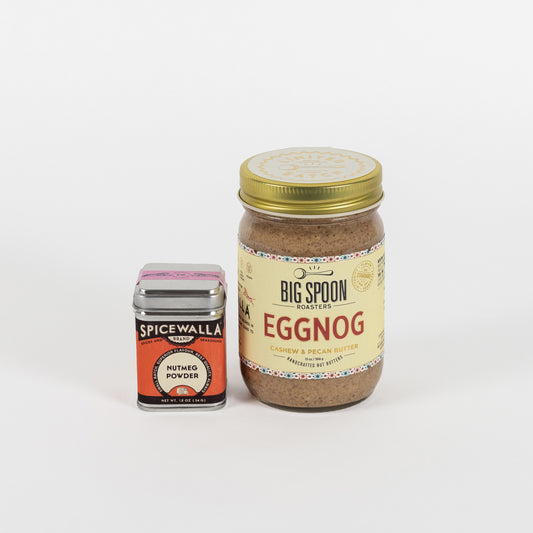


Mark Overbay has been chasing an eggnog nut butter for about a decade. He started working on the idea 10 or 11 years ago but never finished it. This year, a taste of Spicewalla Nutmeg finally sent him back to the mill!
And wow, y'all! The result was something magical... our collaborative, limited-edition Eggnog Nut Butter!
It’s our second jar with Big Spoon Roasters, after the Apple Pie Spice Almond & Pecan Butter in 2021. It’s also the first time Big Spoon has built a nut butter on cashews and pecans together!

Photo of Mark & Megan Overbay selling Big Spoon at farmer's markets in 2011.
Mark and Megan Overbay started Big Spoon in the fall of 2010. The idea goes back to Mark’s Peace Corps service in Zimbabwe, where he roasted local peanuts into a spread. Megan, an endurance athlete, brought the recipes that became their nut butter bars.
They started it as a side project in a rented commercial kitchen in downtown Durham, NC and then made their public debut at the Carrboro Farmers Market in January 2011. Back then, shoppers still asked what nut butter was! Today Big Spoon makes its nut butters and bars from scratch in Hillsborough, NC, just a few hours east of our home in Asheville! That makes them our neighbors twice over: they’re down the road, and they’re another North Carolina maker that cares deeply about its ingredients.
Fifteen-plus years in, Mark still talks about roast levels the way we talk about grinding spices. We had a chance to talk more, and it was so wonderful. His answers are below, in his own words 💜

Photo of Eggnog Nut Butter being made.
SW: At Spicewalla, we obsess over freshness because ground spices start losing aroma soon after grinding. Big Spoon packs nut butter while it's still warm from the mill. What happens to a nut butter's flavour in the weeks after milling, and what have you fought to protect about that process as Big Spoon has grown?
Mark Overbay: One of the most fascinating things about nut butter is that, unlike freshly ground spices, which begin losing some of their most delicate aromatic compounds almost immediately, a well-made nut butter can hold up very well over time and actually become even more flavorful in the days and weeks after it's made.
There's a little bit of alchemy happening inside every jar.
When our freshly roasted nuts come out of the mill, they're warm and wonderfully fragrant. We then slowly mix that base of nut butter with ingredients like spices, sea salt, maple syrup, or a touch of honey, depending on the recipe. Our gentle mixing process is incredibly important. It allows us to evenly distribute the natural oils and other ingredients without compromising the texture or incorporating unnecessary air. We're creating a harmonious, cohesive food, but we're also setting the stage for something that continues to evolve after the jar is sealed.
Over the following days and weeks, the ingredients have time to infuse and mingle. Think about how loose-leaf tea infuses into the water of a teapot. Some flavor compounds are water-soluble, and some are oil-soluble. In our nut butter, which has basically no water content, oil-soluble aromatic compounds from spices gradually infuse the nut oils, while salt and natural sources of sweetness maintain their positions of flavor balance. The result can be a nut butter that tastes even more intensely delicious a few weeks after we make it. It's a great example of how great ingredients, treated with care, can continue doing some of the work for you.
Also, as I mentioned above, we make sure our nut butters are naturally low in moisture, so they are remarkably stable foods when stored properly. We're conservative with our 12-month best-by date, but unopened jars can maintain their quality for a notably long time. I’ve tasted jars 2+ years after they were made, and they were still delicious after a good stir. Speaking of stirring, natural oil separation is a good thing! It means we are not using stabilizers like hydrogenated vegetable oils or palm oil, the latter of which is the #1 cause of deforestation in the developing world. Want to learn more? Please read my blog post: Just Say No to Palm Oil.
However, that's not to say our nut butters are impervious to ageing.
Oxygen and moisture are the mortal enemies of nuts, because oxygen can cause their delicate oils to oxidize and eventually develop off characteristics, i.e., go stale, while moisture introduces its own set of quality and safety concerns.
The fundamentals of our process haven't changed since our first test batches in the fall of 2010: source extraordinary ingredients, roast each nut to its ideal flavor profile, mill and mix with care, and fill and seal our jars in one continuous flow while the nut butter is still warm and aromatic. To maintain the quality that goes into each recipe, keep the jars sealed when you’re not actively using them, avoid introducing water or crumbs into the jar, and store it away from excessive heat and sunlight. Stir back in the separated oils, all the way to the bottom of the jar. If you follow these simple steps, your nut butter experiences will be as good as they get.

Photo of Mark roasting Pecans for the Eggnog Nut Butter.
SW: When we talked, you described roasting the cashews lightly, so they stay out of the way. How do you decide where to land the roast on a new nut, and what does pushing it lighter or darker change in the jar?
Mark Overbay: Roasting is one of my favorite parts of making nut butter because it's where food science, tasting, and intuition really come together. Every nut has its own personality, and our job is to understand it well enough to bring out its best qualities without asking it to become something it's not.
The science behind much of that transformation is the Maillard reaction, a complex series of chemical reactions between amino compounds and reducing sugars that occurs when foods are heated. It's responsible for many of the incredible aromas and flavors we associate with toasted bread, roasted coffee, seared meats, and, of course, roasted nuts. As those reactions progress, hundreds of new flavor and aroma compounds can develop, creating notes that range from buttery and caramel-like to deeply toasted, savory, and almost smoky. However, different nuts respond to roasting in dramatically different ways because their natural compositions of fats, proteins, sugars, and moisture vary.
Cashews, for example, have a naturally mild, creamy, almost flan-like flavor, with a subtle sweetness and a relatively soft, buttery texture.
We love those qualities, especially in a recipe like Eggnog Cashew & Pecan Butter, where we want the cashews to contribute richness and body without overwhelming the delicate interplay of vanilla, nutmeg, and other spices. A lighter roast preserves more of that gentle character. Push cashews too far, and their flavor can become aggressively toasted, with bitter notes that compete with everything else in the jar.
Pecans, the other nut in Eggnog, are another favorite because they can handle a deeper roast beautifully. Their higher oil content and distinctive flavor chemistry create rich, buttery, almost praline-like notes as they toast. We roast ours darker to develop that comforting, caramel character, while being careful not to cross the line into bitterness.
Our heirloom Mission variety almonds, which are present in many of our other nut butters, have a wonderful depth of flavor, and a medium roast brings out their natural sweetness and toasted character while preserving the complexity that makes this botanical variety of almond so special.
And our High-Oleic Runner peanuts really shine with a medium-dark roast. We want that unmistakable, deeply roasted peanut flavor: “ballpark” bold, slightly sweet, and wonderfully aromatic. The high-oleic varieties we use also have a fatty acid profile that contributes to excellent oxidative stability, which is another advantage that helps preserve their amazing taste over time.
When we're developing a new recipe or testing a nut from a new supplier, I’ll often explore several roast profiles side by side, tasting the nuts both on their own and after milling.
That's an important distinction, because grinding changes the sensory experience dramatically. It releases oils, changes how aromas reach your nose, and alters how flavors coat your palate. Ultimately, we're looking for the point where each nut tastes most like the best possible version of itself.

Photo of Mark at Jacobsen Salt Co. in Oregon
SW: You've described a supply chain as a chain of human lives. Who is one person in yours that our readers should know, and what does that relationship look like up close?
Mark Overbay: I love this question, although I have to admit that choosing just one person feels almost impossible.
We've been fortunate to build relationships with an extraordinary community of farmers, growers, makers, and suppliers over the past fifteen-plus years. Every one of those relationships represents people whose knowledge, dedication, and livelihoods are woven into the food we make.
That said, I'd love to introduce people to Ben Jacobsen, the founder of Jacobsen Salt Co.
Salt is one of those ingredients that people often take for granted, perhaps because it's so familiar. But to me, salt is one of the most important ingredients in the kitchen. It doesn't just add a single flavor to food or make food taste more “salty.”
Used thoughtfully, it amplifies sweetness, balances bitterness, enhances aroma, and brings other flavors into focus. Great salt can make the difference between something merely good and something unforgettable.
By coincidence, Ben started Jacobsen Salt Co. just over 15 years ago, almost exactly when we established Big Spoon Roasters. Both of us were driven by a belief that a familiar American food could be elevated to new heights through craft and determination.
Specifically, Ben built Jacobsen Salt Co. around the belief that American sea salt could be every bit as extraordinary as the celebrated artisan salts of Europe. He began experimenting with harvesting and evaporating seawater from the Oregon coast (one handheld bucket at a time!), refining his methods through countless trials before creating a simply magnificent, natural-flake sea salt.
One thing I love about his story is that he approached something as ancient and seemingly simple as salt making with curiosity, humility, and an almost obsessive commitment to quality.
He recognized that the cold, mineral-rich waters of the Pacific Northwest could produce something truly exceptional, and that realizing their potential would require patience, experimentation, and an enormous amount of hands-on work.
The result is, in my opinion, the best salt in the world.
Jacobsen's sea salt has a distinctively clean brininess and a nuanced mineral character that enhances other ingredients and provides the perfect note of salt without all the sodium of more processed versions. It's our go-to salt for all our recipes, and I can't imagine making Big Spoon nut butters or bars without it. Also, when we buy salt from Jacobsen, we’re supporting a fellow maker, a team of skilled people, and a philosophy of food production that we believe matters.
That's what I mean when I say a supply chain is really a chain of human lives.
Every purchasing decision connects us to someone's work, someone's community, and someone's vision for what food can be. We want those connections to be something we're proud of, and they are.
 Photo of Eggnog Nut Butter, before it's jarred.
SW: Eggnog Nut Butter is the first time Big Spoon has paired cashews and pecans. Walk us through the development. How many rounds did it take?
Mark Overbay: Yes! This is the first time we've used ground cashews and pecans together as the foundation of one of our nut butters, and I'm really excited about what we discovered. It's one of those combinations that makes so much sense in retrospect that it makes me wonder why we didn't try it years ago.
I first started experimenting with eggnog-inspired nut butter recipes 10 or 11 years ago, and I've seen quite a few "eggnog" themed products come and go since.
This year, a taste of Spicewalla's nutmeg was the spark needed to finally finish this recipe, and the result, I think, is unlike any other eggnog-inspired product out there.
To me, the three most basic dimensions of nuts are:
- type,
- roast profile,
-
texture (milling or grinding fineness)
I experimented with quite a few combinations before landing on a blend of finely ground, lightly roasted cashews and more coarsely ground, darkly roasted pecans.
The cashews bring a gorgeous natural sweetness and creaminess, while the pecans contribute deeper, buttery, caramelized flavors and a satisfying texture. Something about this "high-low" combination makes the best qualities of the nutmeg pop.
From there, I built the recipe in layers.
Spicewalla's nutmeg was always going to be a star of this nut butter. I wanted that unmistakable, intoxicating aroma to greet you the moment you opened the jar. But nutmeg is powerful, so the challenge was giving it room to shine without overwhelming the more delicate ingredients.
I brought in pure Vermont maple syrup for gentle sweetness and those lovely sweet woodsy notes, ground Ugandan vanilla beans for aromatic warmth and roundness, and Jacobsen sea salt to bring everything into focus.
The goal was to create an entirely new expression of the classic eggnog experience in nut butter form, with the character of the nuts still very much present.

Limited edition Eggnog Butter featuring Spicewalla's Nutmeg!
SW: Nutmeg carries this jar. How did you find the line between tasting like eggnog and tasting like a spice cabinet? And what changes for you when a key spice comes from a partner instead of your own pantry?
Mark Overbay: For me, it's all about balance. I probably use musical analogies more than I should, but I often think of a recipe as a band, with each ingredient playing a different instrument. You want to hear the guitar, the bass, the drums, the vocals. Sometimes you want a great solo, and sometimes an instrument needs to hang back and support the others. But if one musician is playing so loudly that you can't hear anyone else, the song falls apart.
That's how I think about nutmeg in this recipe.
It's absolutely the lead vocalist, but I still want to hear the cashews, the pecans, the maple syrup, and the vanilla. They're all contributing something essential to the finished experience.
Nutmeg is especially interesting because its aroma is so complex. There's warmth and woodiness, of course, but also floral, sweet, and almost peppery notes. In the right concentration, those qualities are incredibly comforting and evocative. But add just a little too much, and suddenly you're tasting the spice rather than the food.
We wanted people to think, "Wow, this tastes like the holidays!" rather than, "Wow, that's a lot of nutmeg!"
Spicewalla is a joy to work with because their spices have so much freshness and aromatic intensity. When you're working with ingredients of that quality, you don't need to use them aggressively to make an impression. In fact, their complexity gives you more room to be subtle.
There's a wonderful principle in music that the space between the notes is just as important as the notes themselves. I think the same is true in cooking. Sometimes the most important decision you make is what not to add.
 The Sweetest Bean team processing vanilla beans in Uganda.
SW: You admitted you were skeptical when The Sweetest Bean told you they grind the whole vanilla pod. What won you over? Tell us a little about the people in Uganda who cure and process that vanilla.
Mark Overbay: I was definitely skeptical! When something sounds so different from what you've been taught...and almost too good to be true...it's natural to approach it with a little suspicion.
Like most folks who have studied professional cookbooks or received pastry training, I learned to treat vanilla beans almost ceremoniously. You split the pod lengthwise with a sharp knife, carefully scrape out those precious little seeds, and use them to infuse whatever you're making. The pod might go into a jar of sugar or a pot of cream, but the seeds were always considered the prize.
So when I first learned that The Sweetest Bean was drying and grinding the entire vanilla pod into powder, my immediate reaction was, "Wait, they're doing what? Does it taste good?"
But here's what they understood that I hadn't fully appreciated: the pod itself contains a tremendous amount of delicious flavor. Those dark, fragrant outer walls are part of the plant and completely edible when prepared with the right care.
With skilled curing, drying, and milling, the whole bean can become an aromatic powder that captures a much broader expression of vanilla's natural complexity.
Tasting is believing!
Their vanilla powder has this remarkable depth and warmth that goes far beyond the one-dimensional sweetness that is easy to associate with many types of vanilla powders and extracts. There are naturally floral, woody, almost chocolate-like notes that make The Sweetest Bean’s vanilla perfect in recipes built around roasted nuts and spices. I genuinely think it's the best-tasting vanilla powder on the planet.
Their vanilla is grown in Uganda, which has ideal growing conditions for the plant (a warm, humid growing environment in which vanilla orchids can thrive) and Ugandan beans are known for their plumpness, rich aroma, and intense flavor.
Producing exceptional vanilla is still an enormous amount of work, and much of that work happens long before a bean reaches someone like us.
Vanilla orchids require careful cultivation, and their flowers must typically be pollinated by hand. Each flower has an incredibly brief window in which it can be pollinated successfully. After the pods mature and are harvested, they undergo a labor-intensive curing process involving carefully managed heat, moisture, drying, and conditioning. This is where much of the familiar vanilla aroma develops.
Behind every finished bean are farmers and processors whose expertise has been developed through years of experience. That expertise is something else I appreciate about The Sweetest Bean, and the story of how The Sweetest Bean came to be makes that connection even more meaningful.
Around 2005, one of its founders, Laura, travelled from Colorado to Uganda hoping to make a documentary film. Instead, she met a group of children living and working on the streets near Kampala, and that encounter changed the course of her life.
She ended up spending seven years in Uganda, working alongside these young people to build businesses that could help support their education and create opportunities for their futures. Those ventures ranged from farming and taxi services to a community radio station. What started as a filmmaking project became a much deeper commitment to a community and its long-term well-being.
As those children grew into young adults, the question became how to create meaningful, sustainable employment that would allow them to build independent lives and support their families.
That question eventually helped inspire the launch of The Sweetest Bean in 2014.
Today, Laura and her longtime friend and business partner, Shana, have built The Sweetest Bean around a simple but powerful belief that we share: that business can be a force for good. They source their vanilla through a direct, long-term relationship with the same Ugandan community where Laura's journey began, with the goal of supporting local livelihoods and building something that can endure for generations.

Big Spoon x Spicewalla's Apple Pie Nut Butter, 2021.
SW: This is our second jar together, after the Apple Pie Spice Almond & Pecan Butter in 2021. What makes a collaboration with another maker worth the extra work, and what keeps you coming back to this one?
Mark Overbay: This is exactly the kind of "work" we love! There's something energizing about getting together with people who are as passionate about their craft as you are. When we first collaborated with Spicewalla on our Apple Pie Spice Almond & Pecan Butter in 2021, it felt like such a natural fit.
We're both North Carolina companies with deep culinary roots, a love of exceptional ingredients, and a belief that food should be exciting, joyful, and full of personality. We're also both obsessive about the details, which I think is a good quality in a food maker!
We've always admired the way Meherwan and Molly have built Spicewalla around a chef's understanding of flavor and a genuine appreciation for the cultural traditions and agricultural communities behind their spices. There's so much curiosity and generosity in their approach to food, and those are qualities we really value in a collaborative partner, and which we seek to nurture within ourselves.
The extra effort around a collaboration usually means more ideas to consider, more decisions to make, and more moving parts to coordinate. But when you're working with people who share your values, those bits of extra activity become part of the fun. You're learning from each other, inspiring each other creatively, and discovering combinations that might not have occurred to either team independently.
I also love that both of our collaborations have represented flavor profiles that carry a sense of nostalgia and celebration.
Apple pie and eggnog are deeply familiar, comforting parts of our lives, and we’ve been able to reimagine them in ways that feel fresh and surprising. Ultimately, I think that's what makes a collaboration worth doing: when the finished food tells a story that's richer than either maker could tell alone. Working with Spicewalla feels like getting to make something wonderful with friends.

Photo of Mark & Megan Overbay, founders of Big Spoon Roaster.
SW: 15 years in, what about Big Spoon today would surprise the guy selling jars at the Carrboro Farmers Market in 2011?
Mark Overbay: When Megan and I started Big Spoon Roasters in the fall of 2010 (making our public debut in January 2011), we had a simple goal for our small, values-based business: we wanted to change the way people felt about nut butter through a business that was good for people and the planet.
We believed that something as familiar and humble as peanut butter could be extraordinary when made with exceptional ingredients, real culinary intention, and genuine care. That belief still drives us.
I think my 2011 self would be amazed by the community we've built around that idea.
Back then, even though American craft food was experiencing somewhat of a renaissance, one of the questions we heard most often at the farmers’ market was, "What is nut butter?"
We were the first company to put the phrase “nut butter” on a product package, and we spent a lot of time explaining that, yes, peanut butter is a nut butter and so is almond butter, but there's an exciting world of culinary possibilities beyond ground peanuts or almonds that may or may not contain salt.
Today, people are much more familiar with the category, and it's also been wonderful to see the growth of curiosity and enthusiasm around thoughtfully made foods, in general.
I'd also be incredibly proud to see how our business has grown without wavering from the principles that inspired it. We have an amazing team, relationships with growers and makers around the world, and customers who care deeply about what goes into their food and how it's made.
Megan and I had dreams of something like this taking shape someday, but we never imagined the reach our dreams would have.
That said, I have to be honest and say that perhaps the biggest surprise, and one of the biggest disappointments, would be how little the broader food industry has changed in 15 years.
When we started Big Spoon, I genuinely believed we were witnessing the beginning of a major transformation in American food culture. Farmers' markets were thriving, people were asking more questions about where their food came from, how it was made, and why some crops received subsidies and some did not.
There also seemed to be a growing appreciation for craft, transparency, and quality. Bon Appétit magazine was doing cover stories about small-scale farmers and the restaurants that support them. That movement of real food has not died, but I thought that in 2026, we'd see a food system that had moved further toward those values.
Instead, mass-produced, highly processed, commodity-grade foods still dominate our grocery shelves.
Venture capital continues to fund countless new food brands chasing the latest trends, while so much of what gets called innovation is really just a mix of chemicals and marketing, or new ways to make processed foods seem healthier. Fewer food companies are even making their own products, instead turning to “co-packers” to make their products in anonymous factories with opaque labor conditions. We have more food businesses launching every year, and “CPG” has become a “cool” space to build a brand, but I'm not convinced we have more real or sustainable food.
That's frustrating, especially when you know how many farmers, growers, and independent makers are out there doing things the right way. It seems more often the case that the people producing truly exceptional food have the fewest resources and face the greatest challenges of getting their products into people's hands.
But I'm also an optimist, and I think there's a tremendous opportunity in all of this.
A friend and I were recently talking about how much of modern life has moved online or into the virtual. The fact that the abbreviation “IRL” is used to qualify so many communications between people is telling. We work through screens, shop through screens, socialize through screens, and increasingly experience the world through some kind of digital filter.
I wonder whether we're approaching a moment when people begin craving the opposite: more tangible, sensory, human experiences. More live music and theater. More gatherings around tables. More farmers markets and independent shops. More opportunities to meet the person who actually grew, cooked, or made something.
Don’t get me wrong; I’m not suggesting we all become luddites. Technology in our pockets that gives us access to information and products around the world is also fun and amazing, but it can be another layer of separation between us and the very real, physical planet we all share.
Food is such a powerful part of our relationship with the “real world” because it engages all of our senses and connects us to people, places, traditions, and memories in ways that a digital experience simply can't replicate.
The late writer and farmer Wendell Berry has had a profound influence on how I think about these things. In his essay The Pleasures of Eating, he writes, "Eating is an agricultural act." I love that simple statement because it reminds us that food doesn't begin on a grocery store shelf or end with a transaction.
Every meal connects us to the land, the people who work it, and the choices we make about the kind of world we want to support.
So maybe the biggest surprise for my 2011 self would be that, all these years later, this work feels just as urgent as it did when we started. In some ways, even more so. I'd also tell that younger version of myself that, incredibly, you and Megan will one day be able to make a reasonable living and even hire a team of people through Big Spoon.
The most rewarding part of this journey is not how much the business has grown. It's the people we've met, the relationships we've built, and the knowledge that we've created something tangible that reflects our values. If the next fifteen years bring a renewed appreciation for real food, skilled craft, and genuine human connection, that's a future we're excited to help make.
Thanks so much for the opportunity to share my perspective!