

For most of human history, we described taste in four categories: sweet, sour, salty, and bitter.
Every culinary tradition in the world organized flavour around these four pillars. It wasn't that anyone thought the system was incomplete. It was that no one had isolated the thing that was missing.
In 1908, a Japanese chemist named Kikunae Ikeda sat down to a bowl of dashi, a simple Japanese broth made from kombu seaweed, and decided to figure out what he was actually tasting.
He knew it wasn't sweet, sour, salty, or bitter. It was something else. Something savory and deep and satisfying in a way that the other four categories didn't capture. He called it umami. In Japanese, the word translates roughly to 'pleasant savory taste.'
It took the rest of the world about a century to catch up.
The Science, Briefly
Working from 12 kilograms of dried kombu, Ikeda isolated the compound responsible for umami taste: glutamic acid. He then neutralized it with sodium hydroxide, producing 30 grams of monosodium glutamate (MSG) and filed a patent for its commercial production.
The following year, Ajinomoto began selling it.
For decades, the Western scientific establishment was sceptical that umami qualified as a basic taste.
That changed in 2002, when researchers confirmed that the human tongue has dedicated receptors specifically for glutamate, placing umami on equal footing with the four tastes that had been recognized for centuries.
What Umami Actually Tastes Like
Even if you've never consciously identified umami, you've probably tasted it thousands of times!
It's the quality that makes a slow-cooked beef broth different from a quick one. The depth in aged parmesan that fresh mozzarella doesn't have. The reason a ripe summer tomato eaten over the sink tastes like an event. And why soy sauce, added to almost anything, makes it taste more like itself.
As Chef Alexander Bourdas explains, "If I were to define umami, I would call it a comfortable taste. I use it to give diners greater pleasure from their food."
Umami is often described as savory, brothy, and mouth-coating. It’s a sensation that lingers on the palate after you've swallowed, making food feel more satisfying and complete. Food scientists describe this as increasing 'palatability': the more umami present, the more compelling food becomes.
Chef Michael Anthony of Gramercy Tavern has described the effect precisely: “Umami is a way to make dishes compelling yet keep them restrained. Discovering umami gives us a chance to create dishes that are irresistible even with just a few ingredients, because it brings the natural deliciousness of those ingredients to the fore."
Where Umami Lives
Glutamate, the amino acid that produces umami, is one of the most abundant compounds in food. It's present in high concentrations in:
- Aged and fermented foods: parmesan, roquefort, miso, soy sauce, fish sauce, anchovies
- Produce: ripe tomatoes, sun-dried tomatoes, dried shiitake mushrooms, corn, green peas, broccoli
- Proteins: cured meats, dried fish, slow-cooked stocks and broths
What fermentation and ageing do to food is largely a story about glutamate.
As proteins break down over time, they release free glutamate, the active form that triggers umami receptors. And delicious items like parmesan have nearly seven times more glutamate per gram than fresh cheddar.
The longer the age, the more concentrated the umami, the higher the glutamate content.
Synergy: Why Umami Compounds
One of the most useful things food scientists have discovered about umami is that it's synergistic.
Glutamate combines with other umami compounds, inosinate (found in meat and fish) and guanylate (found in dried mushrooms), to produce a response that is significantly more intense than any of them alone.
Research published in BioMed Research International found that in humans, the umami response to a mixture of glutamate and inosinate is about eight times larger than the response to glutamate alone. This is why a bolognese made with both meat and tomatoes is so profoundly savory. Why dashi made from kombu and bonito is so much more complex than either ingredient on its own.
The umami in each ingredient amplifies the umami in the other.
MSG: Umami Concentrated
MSG is glutamate in its isolated, concentrated, and stabilized form.
When it's added to food, it delivers the same umami effect as tomatoes, parmesan, and mushrooms, because it's the same compound. Your body doesn't distinguish between them - it’s able to naturally separate the sodium from the glutamate. Because of this, it only sees glutamate, and it triggers the same receptors, the same palatability response, the same satisfying depth.
What MSG does that those other ingredients don't is give you precise control, which is a big reason we love MSG at Spicewalla.
You can add umami depth to something without adding tomato flavour, or without the funk of parmesan, or without the earthiness of mushrooms. It works across savory and sweet applications, cooked and raw, because umami is not a flavour itself. It's an amplifier.
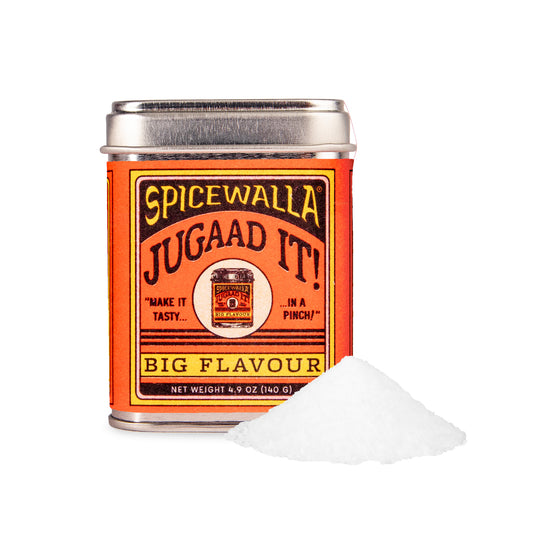
That's the logic behind Jugaad It. Salt, sugar, and MSG together give you the full arc of how flavour is experienced: the opening brightness of salt, the smoothing roundness of sugar, and the deep, lingering satisfaction of umami.
Nothing is missing. Nothing is fighting. The food just tastes more like what it is.