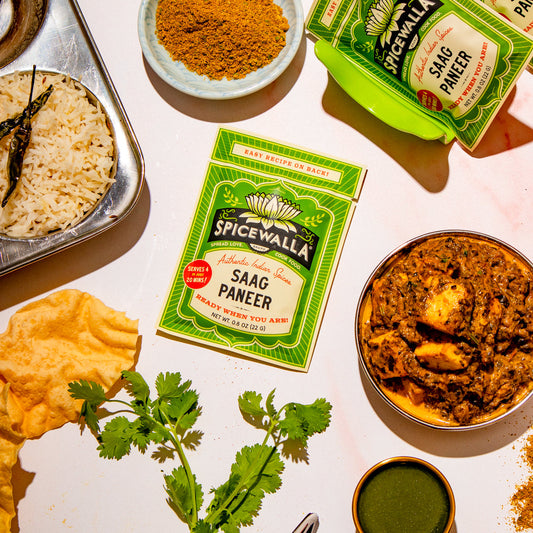


Saag paneer gets called the gateway dish of Indian cooking, and it earns that reputation honestly!
Cubes of paneer sit in a deep green sauce built from greens, garlic, and a spice blend that never shouts. It's the dish people order when they don't know what else to get. It's also the dish most often made wrong outside of Punjab, where it started.
Saag Paneer's Origin Story
Punjab sits in the northwest corner of the Indian subcontinent, split since the 1947 Partition into an Indian state and a Pakistani province that share the name.
The word itself comes from Persian: panj for five, ab for water, a reference to the five rivers (the Sutlej, Beas, Ravi, Chenab, and Jhelum) that run through the region. Those rivers make Punjab some of the most fertile farmland on the subcontinent, and that fertility is the whole story.
Punjab grows wheat and mustard at a scale most regions can't match, and rural kitchens on both sides of the border built their cooking around whatever the fields were producing that week.
In Punjab, saag isn't a specific vegetable. It's a category.
The word means greens, and a Punjabi cook might build it from mustard leaves, spinach, fenugreek, bathua, or whatever came up from the ground that week. Winter is saag season there, when mustard greens (sarson) hit their peak and farm families cook them down slowly, then serve them with corn flatbread and a spoon of ghee. That version, sarson ka saag, sits closer to the dish's roots than almost anything eaten outside India today.
Journalist Simran Sethi put it plainly in an interview with Saveur: saag paneer began as farmers' food, built from what grew nearby, not as a restaurant special. Spinach entered the picture later, and mostly outside India.
Chitra Agrawal, author of Vibrant India, has traced that shift to simple availability. Spinach was easier to find in American and British grocery stores than mustard greens, and diners already knew what it tasted like, so restaurants adjusted the recipe to the ingredient they could actually stock.
What most menus call saag paneer today is really palak paneer: spinach and paneer. The two names get used interchangeably now on both sides of the ocean, and neither one is wrong.
What is Paneer?
Paneer is a cheese that's made by curdling milk with an acid, usually lemon juice or vinegar, then pressing the curds into a firm block. Unlike most cheeses, it holds its shape under heat instead of melting into the sauce.
That's not an accident of the recipe. It's the entire point! The cubes stay intact, soak up whatever they're cooked in, and give you something to bite into against all that soft, spiced greenery.
Where the technique actually came from is genuinely disputed. Food historians point to Persian and Afghan traders, Mughal royal kitchens, and Portuguese settlers in Bengal as competing origins, all dating to the 13th to 17th centuries.
No one theory has won out, but every version agrees on the method: curdle the milk, press the curds, keep the shape.
Behind the Blend: Saag Paneer Spice Packet
Our Saag Paneer spice packet is built around that same balance of comfort and grounding heat.
Cumin and coriander form the base, doing the quiet work every good Indian spice blend needs. Ginger and black pepper add lift, cutting through the richness of the greens. Cayenne keeps a low simmer of heat running underneath everything, never sharp enough to fight the spinach. Cardamom and cinnamon show up at the finish, rounding the blend out with warmth instead of sweetness. Mustard plays a supporting role too, a nod to the dish's Punjabi roots, where mustard greens carried that same sharpness on their own.
Dinner is Served!
The Saag Paneer spice packet carries the full blend. You bring the greens, the paneer (or firm tofu, which takes the marinade just as well), and twenty minutes. That's faster than anything else in our Indian meal packet line! Plus, it's the vegetarian one, which makes it the easy answer for Meatless Mondays.
Chef Meherwan Irani's recipe rides on the back of the packet, and you can find the full walkthrough here: Saag Paneer recipe (directly from the back of the spice packet).