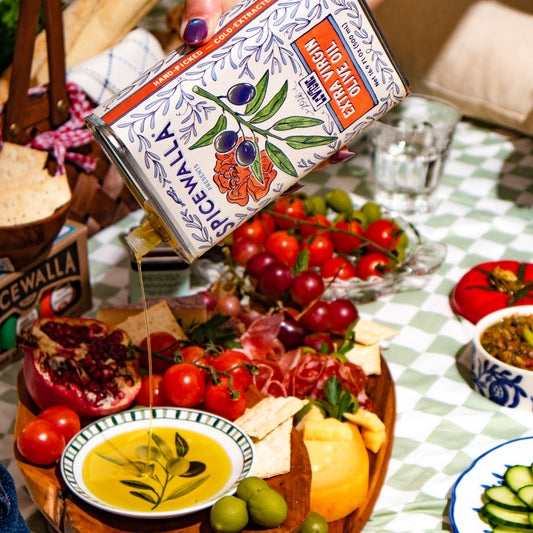


Every olive in a tin of Le Vigne Extra Virgin Olive Oil has the same short biography: it grew on one of about 1,000 trees on a hillside outside Perugia. Someone combed it off a branch by hand. It dropped into a net and never touched the ground. Soon after, it was oil.
That's the whole supply chain.
Nobody trades tankers of oil across borders, and nothing goes into a blending vat. You've asked us a lot about how it works, so we took your questions to the people who run the estate. Their answers start in spring, months before anyone picks a thing.
What happens before the harvest?
The year's work starts in March and April, once the danger of a hard frost has passed. A small team prunes every tree by hand. The goal is a canopy open enough that sunlight reaches each branch and pickers can reach each olive come fall.
Then there's the grass.
Most farms till the ground between rows. Le Vigne doesn't, because olive roots spread wide and shallow, and a plough would tear them up. The grass grows instead.
All summer it gets mowed to about two and a half inches, with the clippings left where they fall. That turf holds the hillside soil in place when the rain comes, and keeping it short means it never competes with the trees for water.
Do you spray the olive trees?
Not with synthetic pesticides. For the past three years the only treatments have been natural ones, and no organic or mineral fertilizer has gone on the land in that time.
The biggest threat is the olive fly, which lays its eggs inside the fruit. Le Vigne's answer is kaolin, a fine white clay sprayed over the trees. It dries into a thin film on the olives, and the flies tend to steer clear. Copper-based foliar sprays round out the care.
When does picking start?
Usually around mid-October. The calendar doesn't make the call, though. The olives do.
The team watches the fruit ripen and picks when it reaches the point that gives the best oil with the most phenolic compounds, the bitter and peppery molecules that make great olive oil taste alive. Wait too long, and riper fruit gives you more oil with less character.
The oil in our 2026 tins came from the harvest at the end of 2025. It was pressed right away and sealed into tins in early 2026.
Why pick by hand when machines are faster?
Machines are rough on fruit. Large commercial groves often shake olives loose mechanically, and a bruised olive starts to oxidize, which is where off-flavours begin.
At Le Vigne, pickers spread nets under each tree and work the olives free with hand combs and small electric rakes. The nets keep fruit off the dirt. Before the olives leave for the mill, a blower separates out leaves and twigs.
Is it slow?
Very. That's the point.
How fast do the olives get to the mill?
Soon after they come off the tree. An olive starts breaking down the moment it leaves the branch. Of everything in this process, that clock might matter most.
Is the oil pressed at the estate?
No, and on purpose. The olives go to Frantoio Il Nocciolino, a local mill Le Vigne has worked with for two years. It isn't a co-op. Le Vigne's olives never get mixed with anyone else's, so the oil in your tin comes from one farm only.
For an estate with about 1,000 trees, buying modern milling equipment and keeping it up to food-safety standards wouldn't make sense. Partnering with a mill that already runs the latest Pieralisi machinery does.
What does "cold-pressed" mean, exactly?
It means nobody adds heat to get the oil out. Heat squeezes out more oil, and it also cooks off aroma and flavour.
At Il Nocciolino, the olives get cleaned with air and water, crushed into a paste with no added heat, and spun in a two-phase decanter that separates the oil. One detail matters more than it sounds: no water goes into the paste.
Traditional three-phase systems add water during extraction, and polyphenols wash away with it. Skip the water, and more of them stay in the oil. That's part of why this harvest tested at 584 mg/kg of polyphenols, nearly double the 300 mg/kg line for a high-polyphenol oil.
Why does the flavour change from year to year?
Olive oil is a farm product, and no two seasons repeat. Nature is unpredictable! Rain, heat, and the exact week of picking all shape the fruit.
Olive trees also alternate on their own, so a heavy crop tends to follow a light one. Le Vigne doesn't push its trees with fertilizer, which means the land sets the pace and the yield swings with it.
This year the land gave us an oil that's greener, grassier, and more peppery than our first release. Same trees. Same hands. A different year.
Taste the harvest
Pour a spoonful of the 2026 Le Vigne Extra Virgin Olive Oil and sip it straight. Green tomato comes first, then ripe fruit, then a peppery catch at the back of your throat. Everything above is in that one swallow.