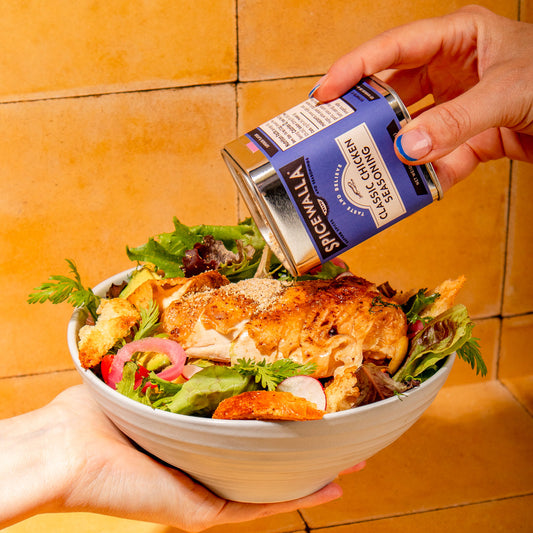


"Classic" is a word that gets thrown around a lot in food. Classic burger. Classic vinaigrette. Classic cookies.
But when something earns the label honestly, it means a long line of cooks figured out what worked and kept coming back to it. Not because it was easy or trendy, but because the combination was right. The flavours made sense together. The food came out well.
That's the idea behind Spicewalla's Classic Chicken Seasoning.
It's not trying to reinvent anything. It's built on a foundation of ingredients that have been seasoning poultry, in various combinations, for centuries: garlic, onion, cumin, oregano, sage, cayenne, and a touch of sugar that does something specific and important when heat gets involved. The result is a blend that makes chicken taste the way chicken is supposed to taste: savory, golden, aromatic, and like you've been at it all day.
A Brief History of Seasoning Poultry
Humans have been cooking chicken for a very long time, and the spices we pair with it didn't end up in our pantries by accident. Most of them arrived through centuries of trade, migration, and the kind of accumulated kitchen knowledge that doesn't get written down so much as passed forward.
Garlic and onion are where most seasoning traditions start. These two alliums appear in kitchens across virtually every culinary culture that has ever existed. It's a pairing so fundamental it barely registers as a choice anymore. They show up together in recipes from ancient Mesopotamia, in the medieval European kitchen, in West African cooking, and in the spice blends of South Asia. Their combination is the savory baseline that everything else builds on.
Cumin has its own remarkable story. According to NPR, "cumin" is the only English word that can be traced directly back to Sumerian, the first written language, where the word gamun appeared in cuneiform script more than 4,000 years ago. The world's oldest known recipe collection, the Yale Culinary Tablets from around 1750 BC, shows that ancient Mesopotamians cooked with generous amounts of onion, garlic, and cumin together. Those three ingredients, in that combination, have been feeding people for almost four thousand years. They're in this tin today.
Sage took a different path to the chicken. Native to the Mediterranean, sage has long been used specifically in stuffings and preparations for poultry and pork. Its assertive, slightly camphor-edged flavour has a natural affinity for the fat in chicken. It cuts through richness rather than competing with it, which is why the pairing has persisted across so many culinary traditions and centuries of cooking.
None of this makes Classic Chicken Seasoning a history project. It makes it a blend with a reason behind every ingredient.
What's in the Blend and Why It Works
Garlic and Onion
These two do the foundational work. Garlic brings sharp, pungent depth that mellows and sweetens under heat. Onion adds a background sweetness and an umami quality that makes the whole blend taste rounder and more complete.
Together, they create the savory core that everything else in the tin builds on.
Cumin
This is the ingredient that makes people stop and think, "What is that?" without being able to name it immediately. Cumin brings a warm, earthy undertone, slightly smoky and faintly nutty, that deepens the savory base without announcing itself.
Ancient Greeks kept cumin at the dining table in its own container, the same way we keep salt and pepper. It was that essential, that constant. In this blend, it does what it has always done: it makes everything around it taste more complete.
Oregano
Oregano provides the herbal brightness that keeps the blend from feeling heavy. It's a Mediterranean herb with a slightly peppery, aromatic quality that cuts through richness and adds a lift to the flavour profile.
In a blend built around savory depth, oregano is what keeps things from becoming one-dimensional. It's also one of the most heat-stable dried herbs, which means it holds up through roasting and grilling rather than cooking off and disappearing.
Sage
Sage is the herb most historically linked to poultry, and that relationship exists for a real reason.
Sage is considered the primary ingredient in poultry seasoning across culinary traditions, with a long history in sausages and stuffings that stretches back centuries. The flavour is assertive: earthy, slightly bitter, with an herbal warmth that lands somewhere between mint and eucalyptus.
It works in this context because chicken has enough fat and richness to hold its own against something that bold. Use sage with a delicate fish, and it overwhelms. Use it with a well-seasoned roast chicken, and it belongs completely.
In this blend, it's used with restraint, providing a background depth that you'd notice immediately if it were gone.
Cayenne
A small amount of cayenne in a blend like this is not about heat. It's about dimension.
At the level it appears here, cayenne adds a background warmth that keeps the palate interested without registering as spice. Think of it as the thing that makes the other flavours more alive rather than a flavour in its own right. It's the difference between a blend that's flat and one that keeps you coming back for another bite.
Sugar
This is the ingredient that does something you can see. When sugar meets the high heat of a grill or a hot oven, it caramelizes, browning and developing complex, slightly bitter-sweet flavor compounds in the process. Alongside the proteins and amino acids in the meat, those same sugars also contribute to the Maillard reaction, which is the browning process responsible for the deep savory crust on well-cooked chicken.
These are distinct processes, but both are at work when this blend hits heat, and both contribute to the golden-brown exterior that makes a roasted or grilled chicken look and taste the way it does when it's done right. Without the sugar, you get cooked chicken. With it, you get the crust everyone is actually after.
How to Use Classic Chicken Seasoning!
The obvious move is the whole roasted chicken, and it's obvious for good reason. Rub the blend all over the bird, get it under the skin where it can work directly against the meat, and let it roast. The fat from the chicken and the sugars in the blend do the rest. Spicewalla's Classic Roasted Chicken with Pan Sauce is the recipe to start with. It's straightforward, reliable, and it shows the blend at its best.
Grilled thighs are the weeknight version. Bone-in, skin-on, two-zone grill method: season generously, sear skin-side down on direct heat to render and crisp the skin, finish over indirect. The sugar caramelizes against the grill heat and the crust that forms is exactly what you want.
Then there's the unexpected one. The Classic Chicken Crackers recipe uses this blend on Chicken in a Biskit crackers with a neutral oil, left overnight to absorb. No cooking required! The result is a snack that's hard to stop eating and genuinely impressive for how little effort it takes. It says something about a seasoning blend when it works that well without any heat involved at all.
Beyond those: toss it with olive oil and vegetables before roasting. Shake it on popcorn. Mix it into softened butter and use that butter on anything. Season croutons with it and watch them disappear before the salad is dressed. The blend is built for chicken, but it's not limited to it.
The Case for Classic
There's a version of "classic" that means safe, expected, uninspired. That's not what this is.
Classic, in the sense that earns the name, means the ingredients have proven themselves over time. The combinations have been tested across cultures and centuries and kitchens and kept because they work.
Garlic, onion, cumin, sage, oregano, cayenne, sugar. Each one with a reason for being there. Each one doing something specific. And all of them together, making chicken taste the way chicken should taste: deeply seasoned, golden-crusted, and like someone who knew what they were doing made it!
That's what classic actually means.